
Erika Povilonytė
Mother-of-Pearl
curated by Mėta Valiušaitytė
4 September – 23 October 2026
Notes on Endurance
“We find beauty not in the thing itself but in the patterns of shadows, the light and the darkness, that one thing against another creates. […] Were it not for shadows, there would be no beauty.”
Jun’ichirō Tanizaki, In Praise of Shadows (1933), trans. Thomas J. Harper and Edward G. Seidensticker (1977), 30.
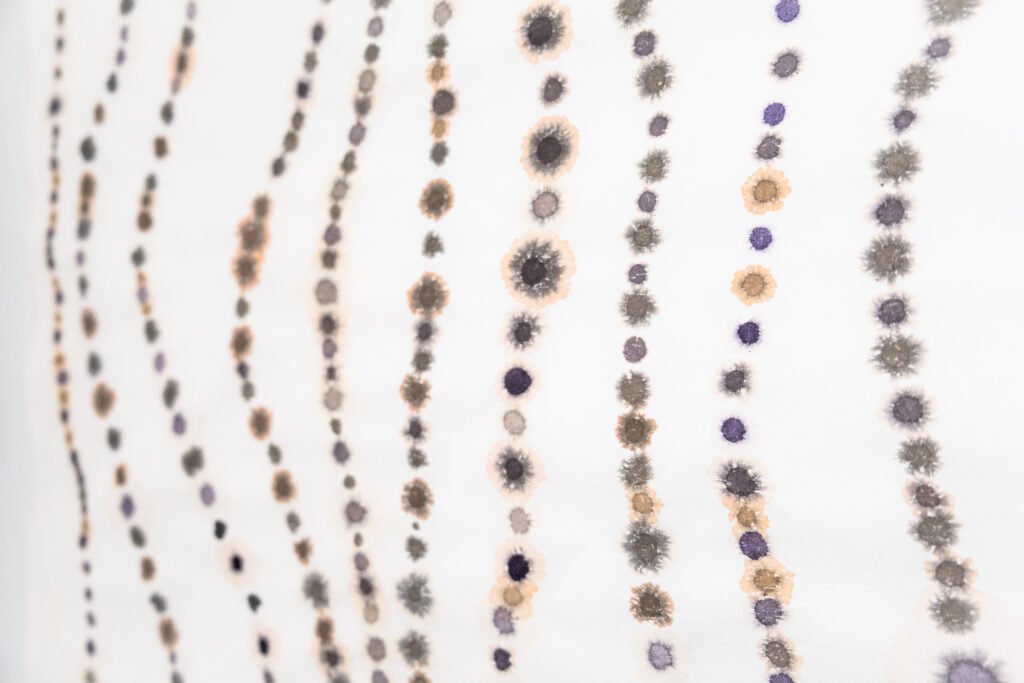
In Mother-of-Pearl, Erika Povilonytė explores what happens when oil paint enters paper.
Upon entering the gallery space, the viewer encounters a blue vessel. Taller than a human body, the form occupies almost the entirety of a vertical 60 x 236 centimeters sheet of handmade mulberry paper. Come closer and fibers of the paper become visible. The uneven edges reveal the thickness of the single sheet. What first appeared as a continuous image begins to dissolve into countless painted marks.
The dots inevitably recall pointillism, the technique of distinct points applied in patterns to form an image, which was developed in France in the end of the 19th century by Georges Seurat and Paul Signac. Yet the resemblance quickly ends. Seurat, who sought to turn painting into a science of vision, applied his dots of pure, unmixed color on an untouched canvas. Meanwhile, Povilonytė meticulously prepares each color on her palette before applying it. As the artist proceeds, she first creates one color with which she marks the paper, causing the foundational form to slowly appear. When her brush touches the paper, both color and form have already been decided. Little is left to spontaneity. After all the dots in one color are placed, she prepares the next color and never returns to the previous one. The image thus develops through successive chromatic strata, each prepared and completed before the next one begins.
Yet more than the dots, the halos around them hold the vessel together as an inseparable body. Laid horizontally, the vessel recalls an excavated body – an image that resonates with Povilonytė’s long-standing interest in archeology. Its title, Jingdezhen vase, refers to the Chinese city long renowned for its porcelain production. Yet the artist has referred repeatedly to the work as her “sick vase.” To understand why, one must first understand the relationship between oil and paper.
Indeed, the paper on which Povilonytė applies her dots is not intended for oil painting. By every academic convention, paper – and especially precious handmade paper – should not receive oil paint. But Povilonytė embraces this incompatibility. She reaches for it, envisioning it as a form of collaboration: “Do I hurt the paper because I do not love it? No. I hurt it because I trust it.”
Educated at one of the oldest national art and design schools in France, the École Nationale Supérieure d’Art et de Design of Dijon and at Accademia di Brera in Milan (Italy), Povilonytė does what she does the best: she paints. But she paints on paper.
European oil painting developed on prepared supports – first wooden panels, later canvas. The introduction of linen canvas in the 16th century was a revolution of a portable and more maneuverable material. By applying pigments bound in oil to prepared surfaces, artists created pictures carried by these supports. Paper belonged to another repertoire: drawing, sketches, watercolor, gouache. Oil on paper certainly existed, but rarely became the principal medium of a painter’s practice. Povilonytė unsettles this distinction. The paper she paints on acts not as a surface for sketching. She treats it, instead, as a painter treats canvas. Thus exploiting everything a canvas cannot do.
After oil paint reaches the paper, its fibers change with time. In the case of Povilonytė’s blue vase, the layers of oil paint are particularly thick. Oil does not remain on the surface. It enters the paper, darkening some fibers and rendering others translucent. Even under normal conditions, it penetrates the paper fibers and thereby slowly alters them. Around every painted dot there forms an oily stain, a halo. The painted dots and their halos give the vessel its tactile body. The accepted rule in art galleries is not to touch the art, and yet Povilonytė’s works on paper draw us in.
Povilonytė asks what happens when paint migrates into paper. The large Jingdezhen vase makes this process particularly visible. The slight blue pigment already present in the paper prompted the artist to cover it with blue dots. The sheet has since survived yet another material transformation.
In September 2025, a fire broke out in Povilonytė’s Dijon apartment. A portion of her works and personal collection burned and were thus irreversibly destroyed. Yet a part of the Taiwan series from the fall 2024 survived, although its material presence changed. Heat accelerated the oxidation of the oil. The halos widened and yellowed.
This transformation recalls the firing of ceramics, which fascinates Povilonytė. The atmosphere inside the kiln forms a ceramic object as much as the clay and glaze shaped by the artist’s hand. Just like the oxidation in the kiln fundamentally affects the final appearance of the objects, the chemically altered atmosphere in Povilonytė’s studio acted upon her surviving works. Having acquired a new material state, they continue to change. Seen in this light, these works are never finished.
***
Mother-of-pearl has no stable color of its own. Its iridescence is produced by microscopic layers that interfere with light. When one changes position, the color changes. The dots in oil that Povilonytė sets on paper operate in a similar way: the color is never determined by pigment alone. It emerges from the interaction of pigment, oil, paper and light. What first appears fragile, proves enduring after all.
Mėta Valiušaitytė, PhD, art historian and curator based between Paris and Berlin
The works presented in the exhibition at Drifts were produced in 2024–2026, mostly during two residencies in Taiwan (autumn 2024 and autumn 2025), where Erika Povilonytė (b. 1997 in Panevėžys) worked with handmade mulberry paper at Goang Xing Paper Factory and spent time in a traditional paper workshop observing and learning traditional papermaking.
Curator, exhibition text author: dr. Mėta Valiušaitytė
Text translation: Paulius Balčytis
Text editing: Rima Bertašavičiūtė
Lighting design: Ugnius Tuleikis
Technical Support: Aleksas Jukumas
Graphic Design: Gerda Adiklytė
Photodocumentation: Vaida Jonušytė
The exhibition is financed by the Lithuanian Council for Culture and the Vilnius City Municipality.